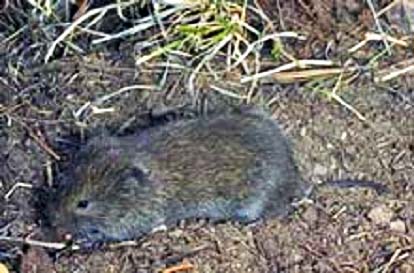
Long-tailed vole
Microtus longicaudus
Area of Distribution
Long-tailed voles are found throughout the western United States and Canada up through southeastern Alaska. Long-tailed voles occupy a variety of habitats, such as dry grassy areas, mountain slopes, forests, stream banks, sagebrush grasslands, mountain meadows, aspen woodlands, and riparian zones.
 Long-tailed vole
|
 Distribution of the Long-tailed vole
|
|
Pictures from - National Museum of Natural History ©2004
Smithsonian Institution
|
Physical characteristics
Long-tailed voles are small bodied with long, bicolor tails. The tail
is about 30% of their total length. The fur color varies with the on
its on its body. The back part of the voles fur is grayish brown with
black tips, while the front fur is light gray color. They are typically
larger than the montane or meadow voles. Total length is 7 to 8.4 inches,
tail length is 2.2 to 3 inches, and they weigh 1.4 to 1.9 ounces.
Reproduction
The breeding season is from May to October and they may breed twice during this time. They have 3 to 6 young.
Ecology
This species does not form well-defined runways like the meadow and
montane vole. The Long-tailed Vole feeds primarily on green plants when
available, and on many underground fungi. It eats roots and bark when
green vegetation is scarce. In winter, these voles spread out across
the mountain slopes in search of food; in summer, they usually retreat
into grassy areas. They are active all year long, and are primarily
nocturnal. One way to reduce their numbers and prevent damage is to
get rid of groundcover such as weeds and overgrown grasses. This limits
their habitat and exposes them to predators. They will tend to avoid
open areas. Their home ranges have been estimated to be about 0.6 acre
for males and 0.5 acre for females.
Signs of Long-tailed Vole Activity
Their runways are 1 to 2 inches wide with matted grass along them that
lead to burrows. The soil may be spongy under foot from their burrowing.
Look for unhealthy plants that may be stressed from damage to the roots
by these voles.
|