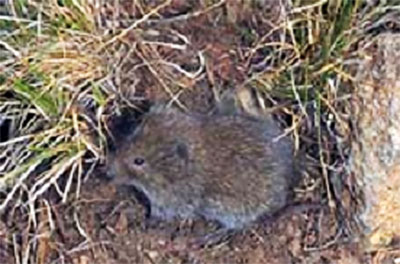
Montane vole
Mountain vole / Microtus montanus
Area of Distribution
The montane vole is found primarily in mountainous regions of the western US. It is found in dry grasslands, alpine meadows, and sagebrush grasslands. The montane vole inhabits gardens and landscaped areas in northern Nevada, the western half of Colorado from 6000 feet to above timberline, in northeastern California and the eastern Sierra slope and the mountain meadows of eastern Oregon. When it is associated with the meadow vole it is generally in the drier habitats.
Montane Vole
|
Distribution of the Montane Vole
|
|
Pictures from - National Museum of Natural History ©2004
Smithsonian Institution
|
Physical characteristics
The montane vole is 5 ½ to 8 ½ inches in length. Its fur is brown, washed with gray or yellow, and mixed with some black-tipped hairs. Its feet are usually silver-gray and the fur under its body is whitish. The tail is bicolor.
Reproduction
Montane voles make a nest of dried grasses that is constructed in a burrow
excavated in moist soil. When the vegetation is green and succulent,
reproduction is stimulated, whereas when the vegetation is dry and mature,
reproduction is inhibited. Mating can occur year round, but is probably
restricted to March - November at the higher elevations. Mated pairs of
montane voles do not share a nest. The male montane vole is promiscuous.
The gestation is 21 days and litter sizes are usually 5-6. The young
wean at about 3 weeks, and the females are sexually mature soon after
weaning. When the populations are low in an area, females abandon the
nest and young after weaning. When populations are high, extended maternal
families are formed in which a female may stay in the nest for 2 successive
litters. So when you see a cluster of burrow openings, it is necessary
to do the Apple Sign Test
to confirm that this is an active area before you place a bait station there.
Ecology
Montane voles spend most of their lives above the ground, but can
also make shallow tunnels in the ground. They are active year round and
are active mostly at night but may also be active during the day. They
prefer runways in open grass but stay and hide where there is a protective
cover from predators such as hawks. Montane voles prefer meadows or
grasslands that have a water source. Their home ranges average about a
quarter of an acre, or 10,000 sq. ft. The Tent setup
with the Vole Control Bait Station is most effective
in controlling voles in the open grassy areas, because they feel safe
from predators while they eat the bait. Occasionally, Montane voles may
have tunnels under the mulch in your landscaped areas, if so, use the
Mulch Covered Method setup of the bait stations
to gain control in these areas.
Signs of Meadow Vole Activity
rook for clipped runways in the grass, piles of clipped grass stems with out the seed heads.

Picture provided by B. Guddat from Nevada
A cluster of many burrow entrance holes is a common sight in lawn and pasture areas where montane voles are present. The home range of this vole is about a 100-foot radius around the entrance holes.
|

Picture provided by B. Guddat from Nevada
Notice the entrance hole at the lower right, and the clipped grass along its runway.
|
|
Montane voles gnaw and girdle trees and saplings at the ground level. Vole gnawing can be differentiated from the gnawing of other animals by the non-uniform gnaw marks. They occur at various angles and in irregular patches. The girdling may be higher in the winter months if snow cover exists. |

Picture provided by B. Guddat
|
Rabbits also chew on young trees, but their gnawing begins several inches above the soil line. Rabbits have much larger teeth than voles and their regular gnaw marks on the trees will show this.
When snow cover is present, voles are protected from predators and their activity can go undetected until it is too late. They can damage the trunks and roots of trees by gnawing. The gnaw marks are about 1/16 to 1/8 inch wide and 3/8 inch long found in irregular patches and at various angles. If this gnawing completely surrounds the root or trunk of the tree or shrub, it will kill the plant. This is called girdling.
It is important to act before vole numbers get too high, especially before winter snow provides cover. The damage they can do to ornamental plants, trees, and garden plants can be quite severe and take several years to replace.
With their high reproductive potential, any remaining voles could repopulate
an area quickly. With this potential for severe damage to your landscape
and garden, a homeowner cannot afford to do nothing and assume a predator
will control the problem. You must take immediate action to prevent the
loss of valuable plantings. Effective action involves using the
Vole Control Bait Station System,
habitat modification, and regular monitoring in the fall and spring with
the Apple Sign Test to detect
any resurgence from surrounding areas. Pay particular attention to
surrounding areas of your property that have heavy vegetation because such
areas are likely sources of invasions.
|