Microtus ochrogaster
Area of Distribution: Prairie voles live in the central grasslands of North America from central Canada to Oklahoma, east of the Rocky Mountains to West Virginia. It is the most common vole of the Great Plains grasslands. When it is associated with the meadow vole it is generally in the drier habitats.
Above ground foraging Prairie Vole populations can be controlled with the Vole Control Bait Station System in the Tent Set-up Method.
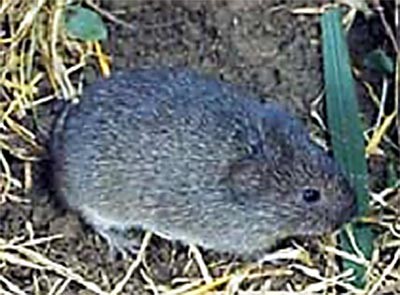 Prairie vole |
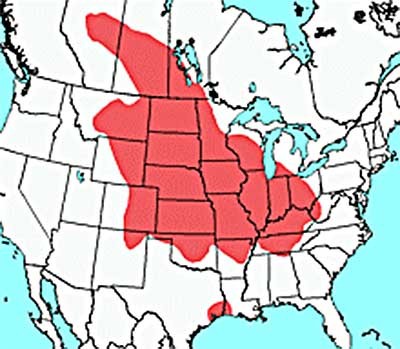 Distribution of the Prairie vole |
| Pictures from - National Museum of Natural History ©2004 Smithsonian Institution | |
Physical characteristics: The Prairie voles fur is long and coarse with a mixture of grayish brown and black giving it a "peppery" appearance. The sides of the body are lighter and the belly is yellow to grayish white. Its total length is 5 to 7 inches (nose to tip of tail) and has an average weight of just under 2 ounces. It has a stocky and stubby body, short tail and legs, and its eyes and ears are small.
Reproduction: They have the same partner to help raise and care for their young. The young are born in a ball-shaped nest of dry grass that is usually underground or in a small depression on top of the ground. The young are born hairless and develop rapidly, acquiring a brown coat of fur by day two, crawling three days later, and eating solid food by day 12. They are weaned at 2-3 weeks, and are fully grown by two months.
Ecology: Prairie voles build well-defined runways above and below the ground. They store food in underground chambers for later use during the winter. Prairie voles are highly social. A colony can have runways covering an area as large as a quarter acre. A vole colony consists of a pair of animals but more than likely will include several generations.
Signs of Prairie Vole Activity: The evidence of their presence resembles both meadow and pine vole activity.
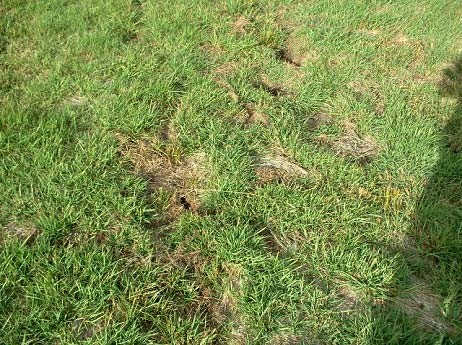 Picture provided by T. Bacchus Picture provided by T. Bacchus
Prairie voles construct surface runways that are easy to recognize by the closely clipped vegetation within them. The small burrow entrance holes lead to underground runways and nesting areas.
|
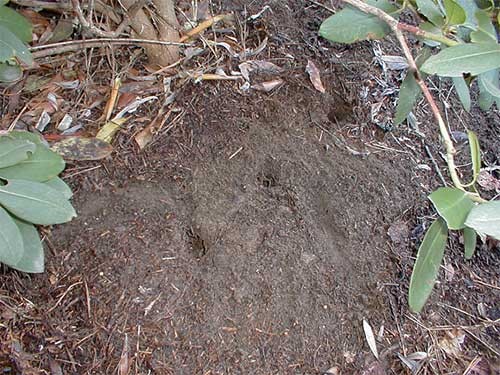 Also, their underground runways can be as extensive as pine voles, where they eat on the roots of your plants. |
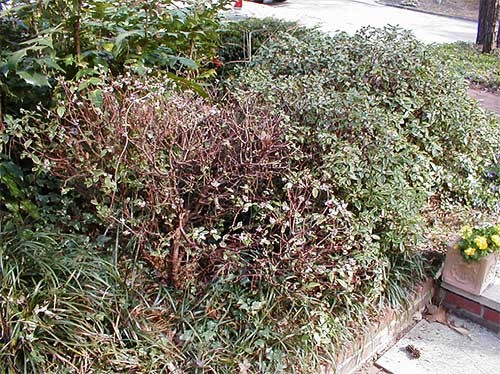 |
Look for signs of stress in your ornamental plantings. Search and feel for underground tunnels around the base of the stressed shrubs that may reveal vole activity. If you detect tunneling, then set up a test in the area with the Apple Sign Test to confirm activity. If voles are the culprits, then install a Vole Control Bait Station System in the area. |
| Prairie voles gnaw and girdle trees and saplings at ground level as well as below ground. Vole gnawing can be differentiated from the gnawing of other animals by the non-uniform gnaw marks. They occur at various angles and in irregular patches. The girdling may be higher in the winter months if snow cover exists. | 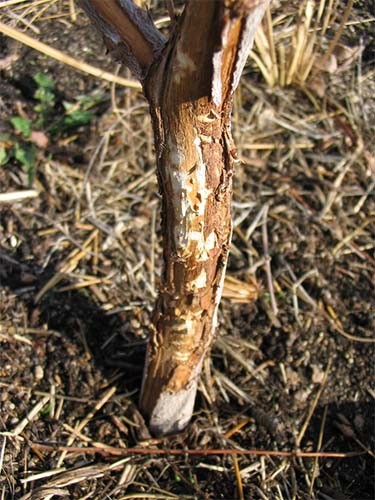 Picture provided by B. Guddat Picture provided by B. Guddat |
Rabbits also chew on young trees, but their gnawing begins several inches above the soil line. Rabbits have much larger teeth than voles and their regular gnaw marks on the trees will show this.
When snow cover is present, voles are protected from predators and their activity can go undetected until it is too late. They can damage the trunks and roots of trees by gnawing. The gnaw marks are about 1/16 to 1/8 inch wide and 3/8 inch long found in irregular patches and at various angles. If this gnawing completely surrounds the root or trunk of the tree or shrub, it will kill the plant. This is called girdling.
It is important to act before vole numbers get too high, especially before winter snow provides cover. The damage they can do to ornamental plants, trees, and garden plants can be quite severe and take several years to replace.
With their high reproductive potential, any remaining voles could re-populate an area quickly. With this potential for severe damage to your landscape and garden, a homeowner cannot afford to do nothing and assume a predator will control the problem. You must take immediate action to prevent the loss of valuable plantings. Effective action involves using the Vole Control Bait Station System, habitat modification, and regular monitoring in the fall and spring with the Apple Sign Test to detect any resurgence from surrounding areas. Pay particular attention to surrounding areas of your property that have heavy vegetation because such areas are likely sources of invasions.